
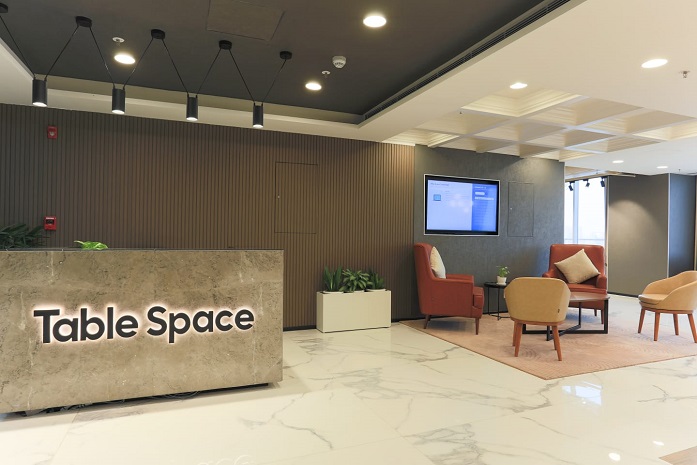
Table Space Pros & Cons Review

Table Space is one of the dominant players in India’s commercial real estate market, pioneer of the Workspace-as-a-Service (WaaS) or enterprise managed office space model. Unlike traditional coworking spaces (like WeWork or Smartworks) that traditionally focus on shared amenities and hot-desking, Table Space builds, owns, and operates fully customized, dedicated, and secure offices exclusively for Fortune 500 companies, Global Capability Centers (GCCs), and large enterprises.
As of 2026, the company manages over 11.5 million square feet of Grade-A office real estate across India’s top tech hubs, including Bengaluru, Hyderabad, Mumbai, Pune, Chennai, and Delhi-NCR.
The Pros: Why Enterprises Choose Table Space
1. Zero Upfront Capital Expenditure (CAPEX)
In a traditional lease, an enterprise must deploy massive upfront capital to fund office design, civil construction, interior fit-outs, and IT networking. Table Space completely eliminates this by absorbing the construction costs and amortizing them into a single, predictable monthly operating expense (OPEX). This frees up capital to be reinvested into core business operations, talent acquisition, or technology.
2. Radical Speed to Market (90-Day Buildouts)
Setting up a conventional corporate office in India typically spans 12 to 18 months due to fragmented vendor management, bureaucratic approvals, and procurement bottlenecks. Table Space uses a vertically integrated model—managing leasing, architecture, construction, and IT in-house—collapsing deployment timelines to approximately 90 days for bespoke builds. For rapid deployment, their “Ready-to-move-in Suites” can be occupied within 24 hours.
3. Institutional-Grade Security and Compliance
For financial services (BFSI), healthcare, and tech enterprises, basic coworking infrastructure fails compliance audits. Table Space designs spaces from the ground up to clear rigorous data privacy and physical security benchmarks, offering:
- Dedicated, isolated IT firewalls and network perimeters (no shared bandwidth with other companies).
- Strict compliance mappings for SOC2, ISO 27001, GDPR, and HIPAA.
- Private access controls, biometrics, and dedicated CCTV monitoring.
4. Single-Point Accountability
Instead of managing dozens of property owners, facility management agencies, interior decorators, and internet providers, enterprises sign a single contract. Table Space acts as the sole vendor responsible for everything from property taxes and structural maintenance to daily housekeeping, cafeteria management, and IT uptime.
5. Multi-City Fluidity
For rapidly growing firms, Table Space allows contractual agility across its pan-India portfolio. If an enterprise needs to scale down its headcount in Bengaluru but rapidly expand its presence in Hyderabad or Mumbai, the contract can often be restructured across the provider’s network, mitigating the risk of unexpired rent liabilities tied to a single rigid landlord lease.
The Cons: The Hidden Trade-offs & Limitations
1. Premium Cost at Scale
While the total cost of ownership (TCO) is highly efficient over a 24-to-36-month horizon when accounting for avoided CAPEX, the monthly per-seat cost carries a premium markup. Table Space builds the cost of risk, capital, and comprehensive facility management into their fee. For ultra-mature operations intending to occupy the exact same real estate for 10+ years with stable headcounts, a traditional long-term lease may eventually prove cheaper.
2. High Minimum Threshold (Inefficient for Small Teams)
Table Space’s enterprise infrastructure, custom governance, and premium real estate assets are optimized for larger floor plates. The model typically favors organizations requiring 50 to 100+ seats or massive multi-floor layouts. Startups, micro-teams, or businesses looking for flexible hot-desking options will find the model cost-prohibitive and structurally incompatible.
3. Limited Physical Autonomy
Because Table Space operates the facility, the enterprise compromises on macro-level control. Major structural modifications, changes to exterior building-level branding, choice of base building amenities, or switching out primary facility management software are constrained by Table Space’s operational frameworks and master landlord agreements.
4. Enterprise Lock-in Clauses
While more flexible than a traditional 9-year commercial lease, bespoke managed spaces still require substantial contract commitments to offset the provider’s build-out costs. Enterprises looking for true month-to-month flexibility will find themselves bound by multi-year lock-in periods typical of customized corporate assets.
Strategic Fit Framework
| Factor | Managed Space (Table Space) | Traditional Office Lease | Coworking Space |
| Capital Model | 100% OPEX (Predictable monthly fee) | High CAPEX (Fit-outs) + OPEX | 100% OPEX |
| Setup Timeline | ~90 days | 12 to 18 months | Instant (Same day) |
| Compliance & Security | Dedicated, enterprise-isolated | Fully customized by you | Shared network, lower privacy |
| Optimal Headcount | 50 to 5,000+ employees | 200+ employees (Long horizon) | 1 to 50 employees |
| Branding & Culture | Full internal customization | Absolute control (Internal & External) | Restricted to private office door |
Table Space last five year growth
Over the last five years, Table Space has transformed from a niche real estate player into India’s largest provider of enterprise-managed workspaces. Fueled by a massive surge in Global Capability Centers (GCCs) setting up operations in India and a post-pandemic shift toward asset-light corporate office models, the company’s growth trajectory is remarkably steep.
1. Portfolio & Footprint Growth (Square Footage)
The most striking metric of Table Space’s growth is its operational footprint. By aggressively leasing premium Grade-A real estate and acquiring assets directly, the company has nearly tripled its portfolio size over the past five years.
- 2.5 to 3 Million Sq. Ft. The company operated a solid but relatively modest footprint, heavily concentrated in tech pockets like Bengaluru.
- 11.5 Million Sq. Ft. The company operates an expansive network of 80+ centers across 8 major Indian cities, officially ranking as the #1 flex workspace operator by operational portfolio size in the country.
- Key Growth Driver: In the financial year alone, Table Space delivered 3.2 million square feet of custom offices across 125+ enterprise projects, representing a massive 45% year-on-year delivery growth. Regional growth was even more explosive—with hyper-expansions in Mumbai (up 250–300%) and Hyderabad (up ~200%).
2. Financial Metrics & Revenue Scaling
This massive physical expansion directly correlates with their top-line financial scaling, backed by major global institutional investors.
- Annual Revenue (ARR): The company’s annual revenue has scaled past $170 million USD (~₹1,400+ crore). This is a dramatic climb from its early days, positioning it as a highly profitable market leader.
- Funding Catalyst: A massive inflection point occurred when global private equity firm Hillhouse Capital injected roughly $402 million into the company over multiple rounds. This war chest allowed Table Space to transition from simply leasing space to buying out massive corporate assets.
- Strategic Asset Acquisitions: Rather than just sub-leasing, they pivoted into property ownership. Notable acquisitions include spending ₹500 crore to acquire a 5.5-lakh sq. ft. facility in Whitefield, Bengaluru, and entering a ₹400 crore joint venture with Panchshil Realty for a 9-lakh sq. ft. facility in Kharadi, Pune.
3. Client & Market Penetration
The profile of the standard Table Space occupier has completely shifted from general corporate offices to highly regulated global giants.
- The GCC Boom: Table Space capitalized perfectly on the “GCC-as-a-Service” trend. Over the last 5 years, global companies realized that navigating Indian local compliance, civil construction, and IT setups was highly inefficient. Table Space took over the entire workflow.
- Current Client Base: The company services 425+ enterprise clients, including a vast network of Fortune 500 companies. Crucially, 1 in every 3 clients is a Global Capability Center (GCC) across sectors like BFSI, aerospace, tech, and healthcare.
- Stickiness & Occupancy: Reflecting a highly sticky business model, Table Space boasts a 90%+ occupancy rate across its entire live portfolio, with a 45% repeat engagement rate—meaning existing enterprise tenants regularly contract them to build out their secondary and tertiary expansion phases.
What Lies Ahead (2026–2029)
Table Space shows no signs of tapping the brakes. The company has officially outlined plans to invest an additional ₹4,500 crore over the next few years to add another 9 million square feet to its portfolio. Their stated roadmap is to push past 18+ million square feet and expand to 120 centers, solidifying their grip on the corporate Workspace-as-a-Service ecosystem.
The Verdict
Table Space is highly effective for global enterprises, expanding GCCs, and mid-to-large corporate operations entering or scaling within India who value speed, compliance, and capital conservation. It successfully bridges the gap between the premium privacy of a traditional corporate headquarters and the financial agility of a shared workspace.
However, if your business requires extreme long-term structural autonomy over a building, consists of a small team under 50 people, or demands immediate month-to-month contractual exits, conventional leases or standard flexible coworking offices remain the more appropriate path.

Lindsey Tarry is a passionate real estate blogger, journalist, and content creator dedicated to breaking down the complexities of the property market. From deep-dive market trends and breaking industry news to practical advice for buyers and sellers, Lindsey crafts engaging stories and articles that keep readers informed and ahead of the curve. When she isn’t writing, she is keeping a close eye on the latest architectural and market shifts.
Leave a Comment