
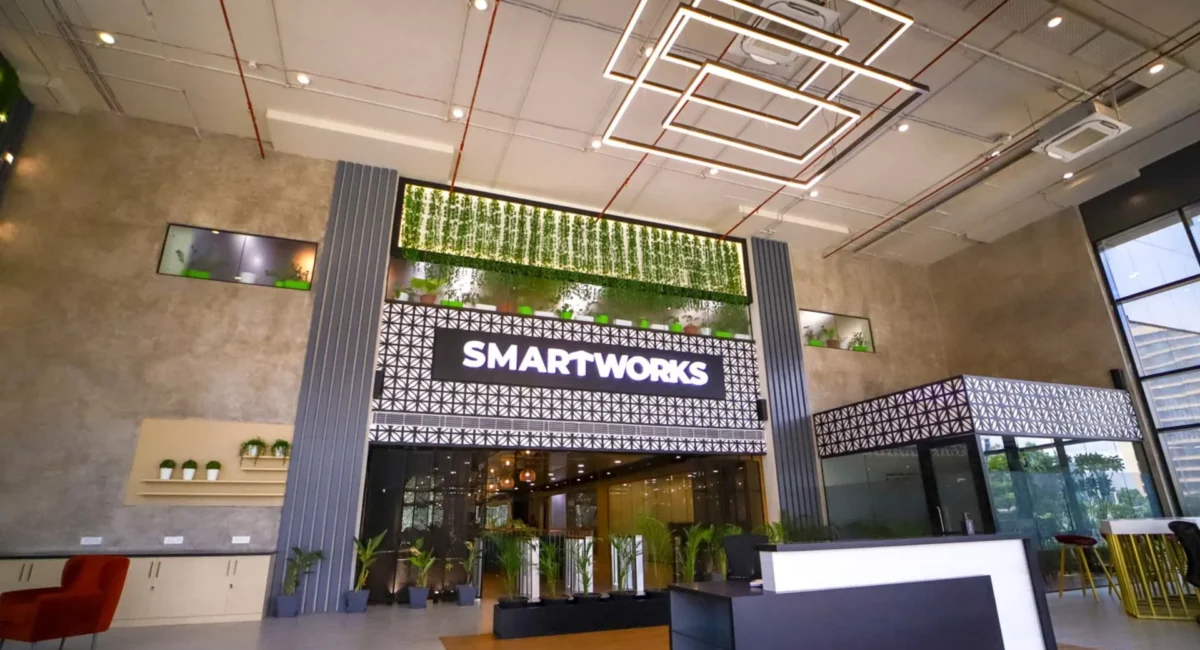
Smartworks Pros & Cons Review

Smartworks is India’s largest provider of enterprise-focused managed office campuses. Listed on the BSE and NSE, the company operates a “campus-led” real estate model.
Instead of leasing single floors or small retail layouts, Smartworks rents entire large-format buildings (often exceeding 300,000 square feet) from primary developers and converts them into tech-enabled, fully serviced corporate environments. Serving over 770+ global giants, Fortune 2000 companies, and Global Capability Centers (GCCs), their current operational footprint spans over 15 million square feet across 15+ major cities.
The Pros: Why Enterprises Choose Smartworks
1. The Managed Campus Ecosystem
Smartworks goes beyond standard desk clusters by building full-scale lifestyle campuses. Because they control entire buildings, their spaces feature massive shared value-adds that mirror tech-giant headquarters:
- Integrated food courts and cafeterias.
- Sports zones, gaming arcades, and fully equipped gyms.
- In-house crèches (daycare centers) and dedicated medical rooms.
- Convenience stores and automated vending bays.
2. Rapid Project Turnaround (45 to 60 Days)
While traditional office fit-outs take up to a year, and bespoke managed spaces typically take 90 days, Smartworks has hyper-standardized its supply chain. They can take a bare-shell property and transform it into a customized, brand-aligned, fully functioning corporate office in 45 to 60 days, making it incredibly efficient for fast-growing operations.
3. Native Smart Tech Infrastructure
True to its name, Smartworks heavily integrates IoT and automated building management into the workplace. Enterprises get access to a completely digitized day-to-day operation:
- App-based visitor management systems and smart parking.
- IoT-enabled smart meeting rooms that can be booked via their custom platform.
- Automated energy-saving and climate control configurations.
- SmartVantage Platform: A dedicated tier designed for massive GCC deployments that wraps large-format workspaces with strategic local business support services.
4. Significant CAPEX Savings & Asset-Light Scaling
By absorbing 100% of the interior architecture, security systems, and initial construction costs, Smartworks translates massive upfront capital investments into a predictable, tax-efficient monthly operational expense (OPEX).
5. Multi-City Footprint for Large Cohorts
With over 66 massive centers, they specialize in the 1,000+ seat cohort. If an enterprise wants to expand simultaneously across tier-1 cities (like Bengaluru, Hyderabad, and Pune) and tier-2 growth hubs, Smartworks offers seamless multi-city contract structures under a single vendor relationship.
The Cons: The Operational Trade-Offs
1. Premium Markups on Shared Overheads
Because Smartworks invests heavily in building out top-tier, campus-wide lifestyle amenities, those costs are factored into the overall seat pricing structure. If your employees simply need high-speed internet and quiet workstations—and don’t actively utilize the gyms, gaming zones, or community centers—you are essentially paying a premium for underutilized luxury.
2. Crowd Congestion in Large Format Campuses
Because their strategy heavily relies on taking over massive, high-density structures, peak hours (morning log-ins, lunch hours, evening exits) can cause logistical friction. Common campus bottlenecks include packed elevator banks, cafeteria lines, and building access control delays during shift rotations.
3. Dependency on Operator Multi-Tenant Infrastructure
While your specific corporate layout is private and securely walled off, you are structurally reliant on Smartworks for central facilities. Issues with centralized central air conditioning, building-wide primary network lines, or external maintenance SLAs are resolved by their team rather than an in-house facility management group completely dedicated to your company.
4. Financial Rigidity for Long-Term Commitments
Though they offer rapid execution, the capital structure for heavily customized layouts still binds enterprises to long-term lease lock-ins (often multiple years) to offset the provider’s fit-out expenses. It does not provide the absolute month-to-month, plug-and-play elasticity found in smaller, agile coworking providers.
Strategic Comparison: Smartworks vs. Competitors
| Metric | Smartworks | Table Space | Basic Coworking (e.g., myHQ/Independent) |
| Primary Focus | Campus-Led Ecosystem (Entire large buildings with shared amenities) | Bespoke Corporate WaaS (Highly isolated floor plates, raw security focus) | Agile Shared Space (Hot desks, micro-offices, high flexibility) |
| Typical Turnaround | 45 to 60 Days (Fastest for large scale) | 90 Days (Custom engineering) | Instant / Plug-and-Play |
| Target Occupier | Large enterprises & GCCs wanting an experiential lifestyle campus | Deeply compliance-driven MNCs needing absolute layout privacy | Early-stage startups, freelancers, and small teams |
| Technology | Heavy IoT integration, building automation app | Isolated IT firewalls, high network governance | Standard commercial Wi-Fi, basic shared printers |
Smartwork Last Five Year Growth
Over the past five years (2021–2026), Smartworks experienced a massive growth inflection. It successfully transitioned from a venture-backed startup into India’s largest corporate managed-office platform by area under management, culminating in a historic initial public offering (IPO) on the NSE and BSE in July 2025.
The company’s macro trajectory over this period highlights a shift from rapid physical scaling to a highly profitable, self-sustaining financial compounding model.
1. Physical Scale & Portfolio Footprint
Smartworks pioneered the “campus-led model” (leasing massive, entire buildings rather than scattered floors), and its real estate footprint expanded aggressively over the last five years.
- The 10 Million Sq. Ft. Milestone: In April 2026, Smartworks officially became India’s first listed flexible workspace provider to cross 10 million square feet of live, operational area.
- Total Portfolio Size: When factoring in letters of intent (LOIs) and pipelines, its total super built-up area reached 16.1 million square feet across 66 massive centers.
- Global Footprint Expansion: The company diversified outside of India’s top tier-1 and tier-2 tech hubs (currently spanning 15 domestic cities) by establishing an international foothold in Singapore, doubling its footprint there to approximately 76,000 square feet.
2. Financial Performance & Turning Profitable
The financial metrics from 2023 through 2026 underscore a business capitalizing heavily on operational leverage.
- Revenue Hyper-Growth: Total revenue skyrocketed from ₹7,114 million (₹711 crore) in FY23 to a staggering ₹17,958 million (₹1,796 crore) in FY26. This represents a remarkable 36% Revenue CAGR over that period.
- First Full Year of Net Profitability: Historically operating at a net loss while funding hyper-expansion (such as a net loss of ₹63.18 crore in FY25), Smartworks recorded its first-ever full year of positive Net Profit (PAT) of ₹10.53 crore in FY26, backed by a massive 5,000%+ net profit spike in Q4 FY26 alone.
- EBITDA Explosion: Normalised EBITDA expanded at a 94% CAGR between FY23 and FY26, climbing to ₹314.4 crore, driven by a 440 basis point margin expansion to ~17.5%.
3. High-Value Enterprise Stickiness
Instead of relying on volatile startup tenants, Smartworks aggressively cornered the institutional and multinational corporation (MNC) segment.
- The Power of Multi-City Clients: Enterprise clients renting 300+ seats now make up 69% of Smartworks’ total layout, and roughly 31% of total rental revenue comes from multi-city clients—companies that scale seamlessly across their network rather than just leasing a single office.
- Stable Occupancy & Long Tenures: The company maintained a stellar 89% mature occupancy rate (hitting 93% committed occupancy in its longest-running centers) with an average client retention tenure of 47 months (nearly 4 years).
- The GCC Catalyst: Smartworks capitalized perfectly on India’s Global Capability Center (GCC) boom. In FY26, dedicated GCC clients contributed over 15% of total rental revenue, paving the way for the rollout of SmartVantage—a premium suite explicitly engineered for massive multinational tech deployments.
Future Horizon (2026–2030)
Backed by an upgraded credit rating (CARE A) and an incredibly strong balance sheet with a net debt-negative position (holding roughly ₹263 crore in cash against ₹207 crore in gross debt), the company’s forward growth pipeline is locked in. Smartworks has publicly stated its next major roadmap objective: expanding its flexible workspace portfolio from 16 million to 30 million square feet by 2030.
The Verdict
Smartworks is an exceptional match for companies that want an premium, employee-centric office experience without the massive headaches of property management and construction delays. It excels at driving employee engagement and retention via its extensive campus lifestyle features.
However, if your business requires an ultra-private facility with zero shared common areas, has tight network/physical security guidelines that reject multi-tenant spaces, or consists of a smaller team that will not leverage the campus ecosystem, standard boutique leases or dedicated standalone managed spaces remain a cleaner operational alternative.

Lindsey Tarry is a passionate real estate blogger, journalist, and content creator dedicated to breaking down the complexities of the property market. From deep-dive market trends and breaking industry news to practical advice for buyers and sellers, Lindsey crafts engaging stories and articles that keep readers informed and ahead of the curve. When she isn’t writing, she is keeping a close eye on the latest architectural and market shifts.
Leave a Comment