
Top GCC Setup Service Providers In India

India’s evolution from a traditional, cost-arbitrage back office to a global strategic powerhouse is complete. Boasting approximately 2,000 Global Capability Centers (GCCs) that employ over 2 million professionals, India has become the default destination for multinational corporations looking to scale engineering, build generative AI applications, and establish centers of excellence (CoEs).
However, entering the Indian market or transitioning an outsourced operation into a fully-owned enterprise footprint requires navigation through a complex landscape of tax regimes, compliance laws, talent architectures, and real estate bottlenecks. Choosing the correct GCC setup service provider is arguably the single most critical decision an enterprise will make during this transformation.
The premier GCC setup service providers in India vary significantly across diverse operational models, sizing tiers, and business objectives.
The Landscape of GCC Consulting Frameworks
The market is bifurcated into four structural archetypes. Identifying which provider matches your enterprise boils down to aligning with one of these foundational models:
| Provider Archetype | Core Strengths | Ideal For | Top Players |
| Pure-Play GCC & Subscriptions | Capital efficiency, rapid time-to-market, unified operations | Tech scale-ups, mid-market enterprises, rapid product-focused setups | ANSR, Wisemonk, Sansovi (GoodWorks), PlugScale |
| Big Four & Global Consultancies | High regulatory compliance, complex tax structuring, strategy | Heavily regulated sectors (BFSI, Healthcare), multi-region setups | EY India, PwC India, Deloitte India, KPMG, Accenture |
| India-Specialist Advisory | Benchmarking, talent intelligence, location analytics | Pre-entry validation, deep compensation, and capability auditing | Zinnov, Avasant |
| Large IT SIs & BOT Specialists | Mass operational scale, legacy technology migration | High-volume operational or IT centers looking for gradual ownership transfer | Infosys, Wipro, Capgemini, Cognizant |
Top GCC Setup Service Providers in India
1. ANSR
ANSR is a pioneer in the “GCC-as-a-Service” model. They have established over 150 centers across India, helping move GCC implementation away from massive capital expenditure (CapEx) investments into an agile, subscription-led operational expenditure (OpEx) framework.
- The Blueprint: ANSR provides a comprehensive, structured environment that covers everything from talent acquisition and employer branding to workspaces and end-to-end operational workflows.
- Strategic Advantage: Their unique alliance with global giants like Accenture offers clients a powerful combination of ANSR’s asset-light setup speed and Accenture’s large-scale systemic integration capabilities.
- Best For: Western enterprises looking for an end-to-end, highly scalable, turnkey infrastructure setup without buying real estate upfront.
2. Wisemonk
Representing the modern wave of digital-first, agile market entry, Wisemonk has emerged as a top choice for fast-growth startups and tech scale-ups. They bridge the gap between traditional Employer of Record (EOR) services and full-service corporate entity creation.
- The Blueprint: Wisemonk enables organizations to start hiring and operating engineering teams instantly using their existing payroll framework, while concurrently executing the legal registration of the client’s localized entity in the background.
- Strategic Advantage: They challenge the heavy up-front retainer structures typical of classic consulting firms by deploying zero-CapEx, pay-as-you-grow models based on per-employee-per-month pricing.
- Best For: Fast-moving mid-market tech and SaaS organizations that need operational teams on the ground in weeks rather than months.
3. Zinnov
Zinnov acts as a data-heavy intelligence anchor for global executive teams making high-stakes location and operational investments. It is widely considered the gold standard for India-centric market research, maturity benchmarking, and strategic advisory.
- The Blueprint: Zinnov offers rich datasets on micro-market talent availability, engineering compensation standards, real estate costs, and competitor density metrics.
- Strategic Advantage: They map exactly where niche tech talent resides (e.g., AI/ML researchers in Bengaluru vs. advanced automotive engineers in Pune) and explicitly track GCC progression from transactional work to core product design.
- Best For: Senior enterprise stakeholders who need data-backed strategies to validate multi-million dollar investments before breaking ground.
4. EY India (GCC Advisory Practice)
For large-scale, enterprise-grade deployments — particularly within highly regulated spaces like banking, financial services, insurance (BFSI), and pharma — EY India commands a dominant market share.
- The Blueprint: Backed by deep structural teams led by sector specialists like Arindam Sen and Manoj Marwah, EY builds robust corporate frameworks designed to navigate complex transfer pricing structures, permanent establishment (PE) risks, and intellectual property compliance.
- Strategic Advantage: EY integrates its proprietary AI infrastructure (like the EY.ai Generative Studio) directly into the design of the center, ensuring the GCC is built as an AI-first, technologically optimized operation on Day One.
- Best For: Fortune 500 multinationals requiring deep regulatory compliance, global mobility tax structures, and absolute legal certainty.
5. PwC India
PwC has packaged its deep advisory roots into an integrated “GCC-as-a-Service” bundle. It balances high-level transactional strategy with direct, hands-on, localized execution.
- The Blueprint: PwC focuses heavily on the operational redesign and reinvention of the capability matrix, moving far beyond mere corporate setup to handle localized real estate procurement, cultural assimilation, and payroll design.
- Strategic Advantage: They are highly sought after for complex transformation projects, such as helping legacy enterprises restructure siloed business units or migrating outsourced vendor operations into fully owned Centers of Excellence.
- Best For: Companies pursuing complex operating models that require both top-tier management consulting and boots-on-the-ground operational execution.
6. Millipixels & PlugScale (Modern Micro-GCC Specialists)
As the tech landscape fragments, a new category of specialized boutiques has emerged to cater to the “Micro-GCC” trend — establishing highly specialized hubs of 10 to 150 people focused on niche innovation rather than massive administrative back-offices.
- The Blueprint: Providers like Millipixels and PlugScale embed themselves deeply within the client’s corporate culture to hire top-tier engineering talent, design collaborative product labs, and manage local operational mechanics with lean agility.
- Strategic Advantage: They leverage advanced, AI-driven talent sourcing engines that slash senior engineering recruitment timelines down from the standard 4-to-5 months to a lean 6-to-8 weeks.
- Best For: Tech companies with $20M to $500M in revenue that want an intimate, high-quality, product-focused engineering center without the overhead of massive global consultancies.
Evaluating the Right Operational Model
When deciding on a provider, selecting the right partner means choosing the organizational vehicle that best fits your business goals:
The Build-Operate-Transfer (BOT) Model: Handled efficiently by large system integrators (Infosys, Capgemini, Cognizant). The vendor builds and runs the center for 2–4 years before transferring full equity and operations to the parent firm.
The Catch: Centers often take on the cultural identity of the IT vendor rather than the parent company, which can create significant retention and operational challenges during the final handover.
The Turnkey Subscription Model: Handled by ANSR or Sansovi. They build the facility, source the talent, and manage day-to-day operations under a clean, subscription-based fee structure. You maintain complete control over the work product from the start.
The Co-Managed Micro-GCC Model: Handled by modern boutique agencies. They help you plant your flag in India quickly with an agile engineering pod, skipping heavy corporate overhead to focus entirely on rapid software delivery and core innovation.
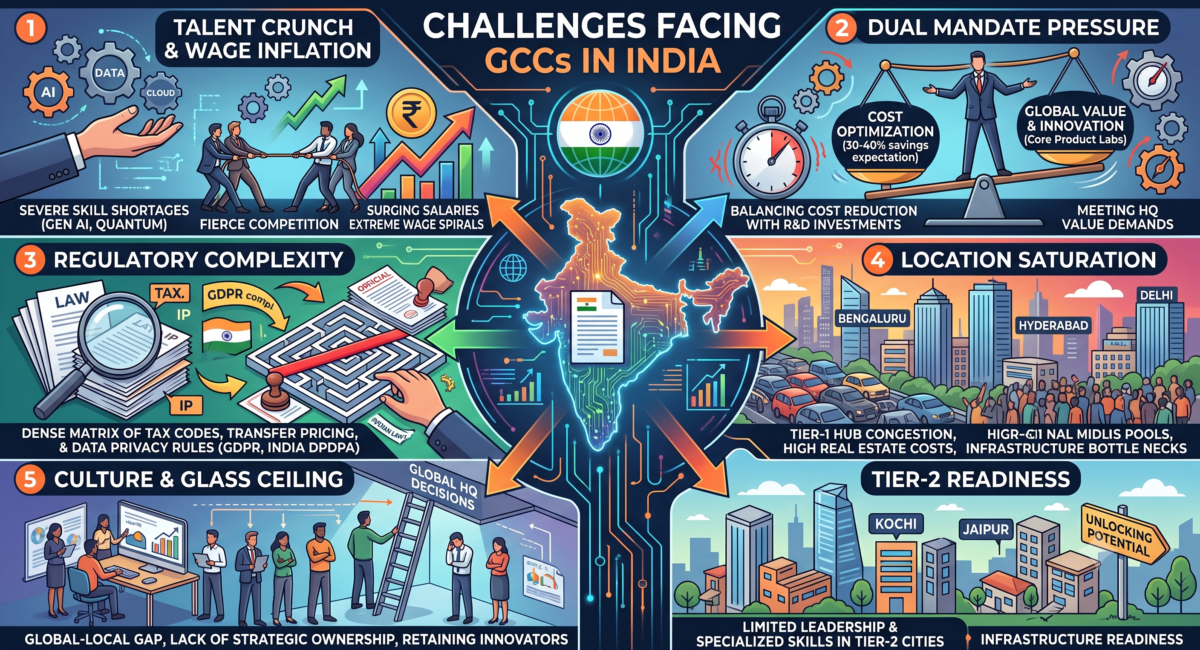
Challanges Face by GCC In India
While India has established itself as the global capital for Global Capability Centers (GCCs)—hosting over 2,100 centers generating nearly $100 billion in revenue—the ecosystem faces structural and strategic headwinds. As GCCs transition from low-cost “back offices” to core innovation hubs driving global product life cycles and generative AI, they encounter a fresh set of modern challenges.
1. The Tech Talent Crunch & Extreme Wage Inflation
While India has an massive volume of tech graduates, there is a severe shortage of specialized, “high-value” talent required for modern operations.
- The Skill Gap: The demand for elite engineers in Generative AI, Quantum Computing, Semiconductor Design, and Cybersecurity vastly outstrips the supply.
- Wage Spirals and Attrition: Because hundreds of Fortune 500 companies are fishing in the same premium talent pool in Bengaluru, Hyderabad, and Pune, bidding wars are common. Top-tier AI architects and full-stack engineering leads are commanding western-equivalent salaries, narrowing the traditional cost-arbitrage window.
2. The “Dual Mandate” Pressure (Cost vs. Value)
Indian GCC leadership faces a challenging corporate paradox known as the Dual Mandate:
- The Expectation: Parent company boards in the US or Europe still expect the Indian entity to deliver significant cost savings (traditionally 30–40% cheaper than onshore operations).
- The Reality: At the same time, they demand that the Indian center build cutting-edge capabilities, spearhead global digital transformation, and take full ownership of product life cycles. Balancing a strict budget while investing heavily in advanced R&D labs and top-shelf talent is an ongoing structural strain.
3. Regulatory and Compliance Complexities
Operating a fully-owned subsidiary in India requires navigating a dense matrix of rapidly evolving laws:
- Data Privacy & Governance: GCCs must continuously align their architecture to comply with international regulations (like Europe’s GDPR) while concurrently managing India’s evolving data protection mandates and local privacy guidelines.
- Transfer Pricing & Audits: Because GCCs operate as related-party entities to their parent companies, they are under intense scrutiny by Indian tax authorities regarding Transfer Pricing (ensuring transactions between the parent and subsidiary are done at “arm’s length”). Navigating these tax audits requires massive administrative overhead.
4. Tier-1 Saturation vs. Tier-2 Readiness
The primary GCC hubs—Bengaluru, Hyderabad, and Delhi-NCR—are reaching physical and financial saturation points.
- The Saturation: Commercial real estate costs, infrastructure bottlenecks, and daily traffic congestion in major tech corridors negatively impact employee experience and drive up operational expenditure (OpEx).
- The Tier-2 Catch-22: While moving to Tier-2 and Tier-3 cities (like Coimbatore, Kochi, Jaipur, or Bhubaneswar) offers 20–30% lower real estate costs and untapped talent, these regions often lack the specialized middle-management and leadership layer required to run highly complex global operations without heavy oversight.
5. Cultural Alignment & “Glass Ceiling” Friction
Transitioning a center from an execution mindset to a strategic leadership mindset introduces corporate friction:
- The Leadership Gap: Many global headquarters struggle to hand over true, end-to-end product ownership to their Indian teams. When the final strategic decisions, budget allocations, and IP control remain entirely at the home office, it creates a “glass ceiling” effect for local leaders.
- Retaining Innovators: Top-tier Indian engineers want to build products, not just maintain legacy code or run automated tests. If a GCC fails to secure actual product architecture mandates from headquarters, its best talent quickly leaves for agile tech startups or rival, high-ownership centers.
Strategic Mitigations
To stay resilient, forward-thinking GCCs are adapting their strategies:
- AI-Native Workflows: Automating repetitive administrative and lower-level code tasks to free up budget and focus resources on higher-value innovation.
- Startup-Ecosystem Linkages: Actively partnering with Indian tech startups, incubators, and academic institutions (like the IITs) to co-create niche solutions rather than relying solely on traditional hiring markets.
- Smart Cost Structures: Utilizing co-managed, asset-light office setups and hybrid-work frameworks to optimize real estate spend.

Lindsey Tarry is a passionate real estate blogger, journalist, and content creator dedicated to breaking down the complexities of the property market. From deep-dive market trends and breaking industry news to practical advice for buyers and sellers, Lindsey crafts engaging stories and articles that keep readers informed and ahead of the curve. When she isn’t writing, she is keeping a close eye on the latest architectural and market shifts.


Leave a Comment