
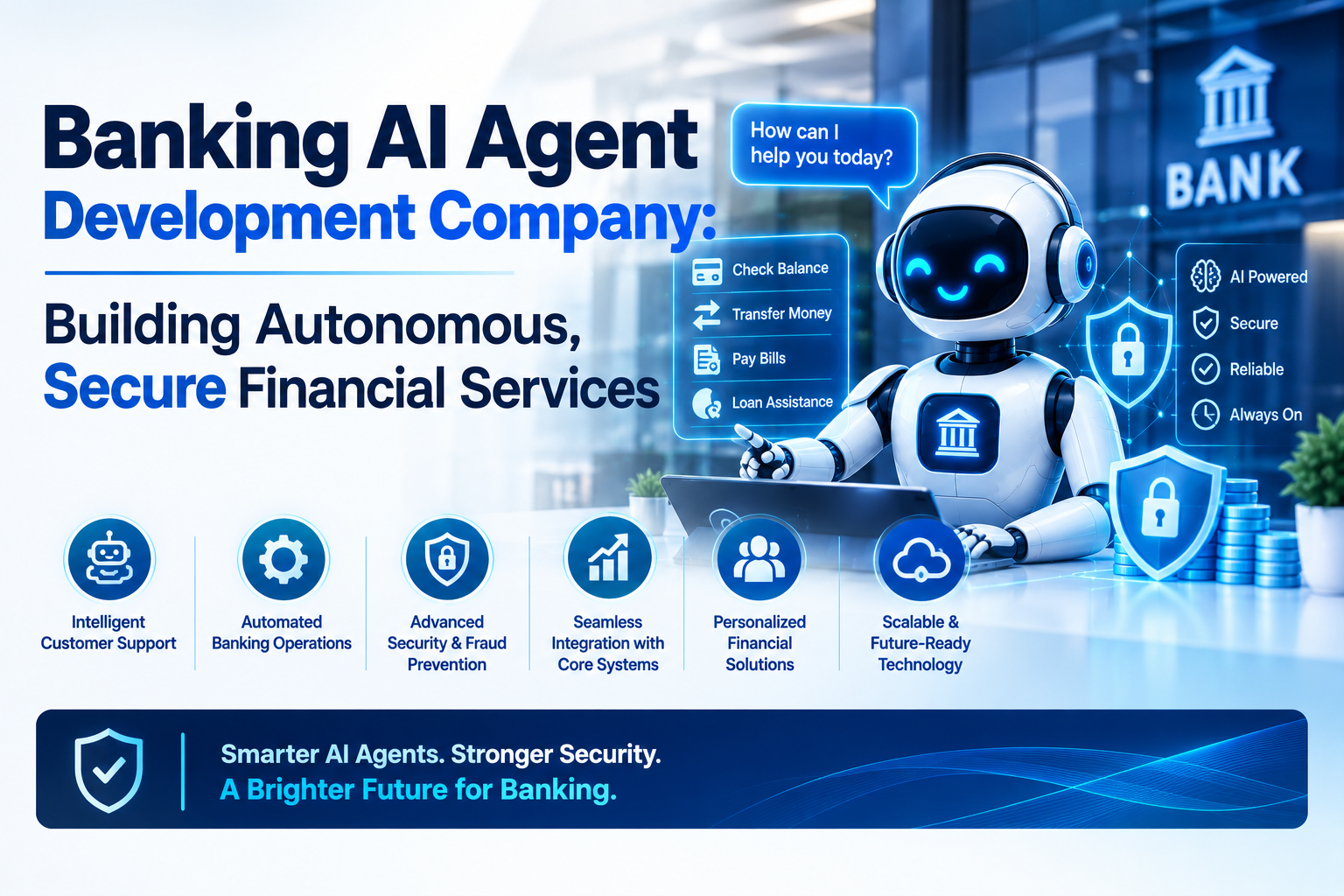
Banking AI Agent Development Company: Building Autonomous, Secure Financial Services

A banking AI system that only answers customer questions is no longer the full vision of intelligent banking. The bigger opportunity is an AI agent that can understand intent, retrieve trusted information, coordinate multiple steps, and support authorized workflows while operating within strict financial controls.
This transition towards agentic AI is becoming increasingly significant for the financial industry. Although this technology is now closer to business practices, its implementation also presents some difficult considerations related to security, accountability, data privacy, governance, and human supervision.
For organizations exploring banking ai agent development company, the priority should therefore be more than building an impressive conversational interface. The real objective is to create an intelligent system that can deliver measurable business value without compromising the controls required in financial services.
Key Highlights of Banking AI Agent Development
Several trends are shaping the development of AI agents for banking:
- AI is moving from question answering toward multi-step workflow execution.
- Internal employee use cases are becoming an important area for deployment.
- Customer-service automation is evolving toward contextual assistance.
- Security integration with enterprise systems is becoming increasingly important.
- Human supervision is still necessary for any important decision making.
- AI governance is now often considered to be a component of the system architecture and not an afterthought.
These trends indicate that successful banking AI will depend on the combination of intelligence, infrastructure, and governance.
From Chatbots to Autonomous Workflows
Classic bank chatbots generally work with preconfigured paths of communication.
They have no trouble answering questions about the usual transactions and providing basic account data or directing customers towards the proper service.
The agentic systems offer additional abilities.
An artificial intelligence agent can decompose a query into several parts, use any permitted software, obtain information from related systems and figure out what should be done next.
Business Benefits for Financial Institutions
Faster Customer Service
AI agents can handle routine requests continuously and at scale. This can reduce dependency on manual responses for straightforward issues while allowing employees to focus on more complex customer needs.
Employee Productivity
AI agents can help banking employees to get policies, summarize customer conversations, prepare cases, and perform repetitive tasks within the workflow.
It is a human-AI collaboration where employees have control over decision making and AI helps in decreasing the burden of paperwork.
Information Consistency
Customers communicate with the banks through websites, applications, call centers, messengers, and other digital channels. AI can help deliver consistent information when responses are grounded in approved knowledge sources.
Consistency is particularly important in financial services because inaccurate or contradictory information can create customer confusion and operational risk.
Scalable Operations
Agentic systems can potentially coordinate repetitive processes across large volumes of requests. However, scalability should be accompanied by monitoring, access controls, and clear escalation mechanisms.
Automation without governance can scale errors just as efficiently as it scales productivity.
In other words, upon a query about suspicious transactions, the agent would identify the suspicious transaction, get any permitted data on it, start the proper workflow of investigation and refer the case to a human when necessary.
The important distinction is that autonomy must be controlled. Financial institutions should not treat the ability to perform an action as evidence that an AI should automatically be authorized to perform it.
Security and Data Governance
The artificial intelligence in banking might have access to highly confidential and private data. This means that security should be incorporated into the system from the very beginning.
Key points include:
- Role-based access controls
- Authentication and authorization
- Encryption and secure data handling
- API security
- Audit logging
- Data minimization
- Permission management
- Continuous monitoring
- Incident-response procedures
An AI agent should only have access to the information and tools necessary for its assigned responsibilities.
This principle becomes increasingly important as agents move from providing recommendations toward taking actions.
Controlled Autonomy Is the New Design Principle
Not every banking task requires the same level of AI independence.
A practical framework can separate AI capabilities into different authority levels:
Assist: The agent provides information, analysis, or recommendations.
Prepare: The agent gathers information and prepares an action for employee approval.
Execute: The agent performs predefined, low-risk activities within explicit permissions.
Escalation: In case the AI is aware of the uncertainties and special cases, it escalates such scenarios to a human agent.
With the help of such a system, companies can automate step-by-step and not give all the powers of automation to AI right away.
Integration With Existing Banking Infrastructure
An AI agent cannot deliver significant operational value if it remains isolated from the systems used by employees and customers.
Successful implementations may require connections with:
- Customer-service platforms
- Knowledge repositories
- Authentication systems
- Workflow applications
- Document-management systems
- Internal databases
- Secure enterprise APIs
- Monitoring and audit systems
Integration also creates technical and security challenges. Every connected system expands the environment that must be governed.
Therefore, AI development should consider architecture, permissions, data flows, and monitoring alongside model capabilities.
The Role of Generative AI Companies
The growing demand for banking AI is creating a broader role for generative AI companies. Their responsibility is increasingly extending beyond model integration toward complete AI engineering and operational governance.
A capable development partner needs to understand areas such as:
- Agent orchestration
- Enterprise AI integration
- Data engineering
- Security architecture
- AI evaluation
- Workflow automation
- Human-in-the-loop systems
- Monitoring and observability
- Responsible AI governance
The strongest implementations begin with a clearly defined banking problem and then determine where AI can safely create value.
Starting with technology first and searching for a business problem later can result in unnecessary complexity and weak adoption.
Challenges That Financial Institutions Must Address
AI agents introduce risks that traditional software systems may not face in the same way.
Hallucinations and unreliable outputs can create operational problems. Poor-quality data can affect recommendations. Legacy infrastructure can make integration difficult. Cybersecurity threats may become more complex when AI can interact with enterprise tools.
Accountability is also an issue.
In case an independent system makes a wrong recommendation or engages in a wrong act, there should be mechanisms for determining what went wrong and what needs to be done to correct it.
The process of testing should thus move away from the regular dialogue. AI agents should be evaluated against ambiguous requests, unexpected inputs, adversarial scenarios, permission boundaries, and failure conditions.
What the Future Looks Like
The future of banking AI will not be determined simply by which system produces the most sophisticated responses. The bigger issue will be whether an AI agent is able to perform effectively within the limits imposed by the policies, structures, and risks of the financial institutions.
In terms of a banking AI agent development company, it will mean that the next generation of products will have to ensure the balance between autonomy and control, between intelligence and transparency, and between automation and responsibility.
For the financial institutions, it will mean working on practical use cases where AI can add value while still having the human decision-making element in place.
The defining advantage of agentic banking will not be giving AI unlimited freedom. It will be giving AI the right level of authority for the right task, supported by the right safeguards.
That is where intelligent automation becomes responsible financial innovation—and where the next generation of banking experiences will be built.
- Company Name: Streebo
- Company Registration Number (EIN, CRN, ACN, CIN, etc): NA










Leave a Comment