
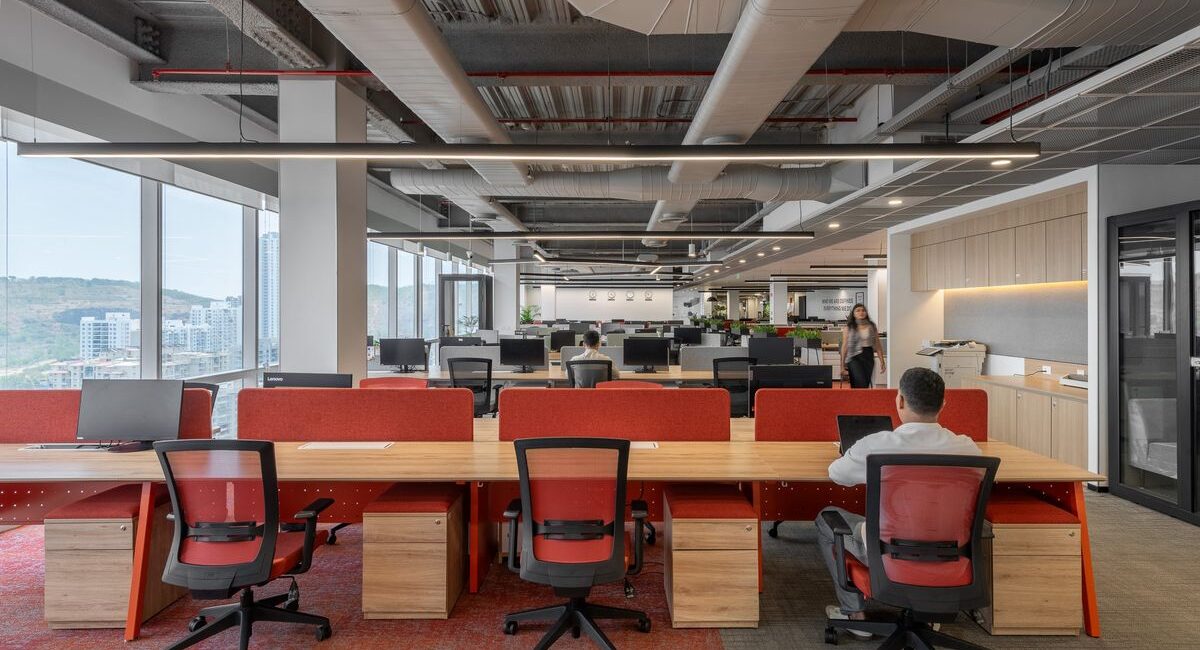
GCC office space demand India 2026
In 2026, the Indian commercial real estate (CRE) sector has officially decoupled from global volatility, driven by a structural shift in Global Capability Centers (GCCs). No longer mere back-office extensions, GCCs have evolved into high-value innovation hubs, commanding over 40% of the total Grade A office leasing in India.
For real estate builders and stakeholders, the 2026 landscape is defined by “Flight to Quality” and the emergence of “AI-Ready” infrastructure.
The GCC Real Estate Surge: 2026 Market Outlook
The demand for GCC office space in India is projected to hit an incremental 50–55 million sq. ft. between 2026 and 2027. This momentum is fueled by the expansion of existing centers and a wave of new entrants—particularly from the UK, Germany, and Japan—aiming to tap into India’s AI and engineering talent.
1. The “AI-Native” Office: New Technical Benchmarks
As GCCs shift toward Agentic AI and high-scale engineering, the requirements for builders have moved beyond standard aesthetics.
- High Power Density: AI labs and R&D centers now require 1.5x to 2x the standard power load per sq. ft. to support localized server clusters and high-performance computing.
- Smart Footage: Modern GCCs are moving from “Square Footage” to “Smart Footage,” integrating building management systems (BMS) that use AI to optimize energy based on real-time occupancy.
- Sustainability as a Mandate: In 2026, roughly 75% of all GCC leasing is concentrated in green-certified assets (LEED Gold/Platinum), as global parent companies align with stringent ESG (Environmental, Social, and Governance) goals.
2. Micro-Market Shifts: Tier-1 Consolidation vs. Tier-2 Rush
While the “Big Three” continue to lead, the geography of GCC demand is diversifying:
- Bengaluru (The AI Capital): Continues to dominate with a 40% share of all GCC leasing. Demand is concentrated in Outer Ring Road (ORR) and North Bengaluru.
- Hyderabad (The R&D Hub): Emerging as a leader for semiconductor and life sciences GCCs, with Hitech City and Gachibowli remaining high-demand zones.
- The Rise of “Challenger Cities”: Cities like Kochi, Jaipur, Coimbatore, and Indore are seeing a “Hub-and-Spoke” boom. Developers who have pre-leased Grade A stock in these cities are seeing 15% faster absorption than Tier-1 counterparts.
3. Impact of Union Budget 2026 on CRE
The February 2026 Union Budget has provided a significant tailwind for builders catering to GCCs:
- Safe Harbour 2.0: By raising the safe harbour threshold from ₹300 crore to ₹2,000 crore, the government has encouraged mid-sized centers to scale rapidly, leading to larger floor-plate requirements.
- Uniform 15.5% Margin: This tax clarity has reduced litigation risks for MNCs, leading to longer lease commitments (7–10 years) compared to the 3–5 year cycles of the past.
- REIT Expansion: With SEBI’s new reclassifications, GCC-occupied assets are becoming the “Gold Standard” for REIT portfolios, ensuring high liquidity for builders of prime commercial assets.
4 Crucial Trends for Real Estate Industry Professionals
| Trend | Opportunity for Builders |
| Magnetic Offices | Building premium amenities (wellness zones, high-end F&B, biophilic design) to entice hybrid workers back. |
| Flex-and-Core | Developing hybrid models where a GCC takes 70% long-term lease and 30% flexible “on-demand” space. |
| Data Privacy (DPDP) | Implementing physically secure “Clean Rooms” and data-segregated zones within the office floor. |
| Edge Connectivity | Providing low-latency, dedicated fiber lines to satisfy the needs of real-time AI processing centers. |
Conclusion: A $100 Billion Opportunity
With the number of GCCs in India expected to surpass 2,500 by 2030, the real estate industry is no longer just selling “space.” Builders in 2026 are now strategic partners in a global firm’s innovation journey. To win in this market, developers must transition from being “landlords” to “ecosystem providers,” focusing on sustainability, high-spec tech infrastructure, and regional flexibility.
Leave a Comment