
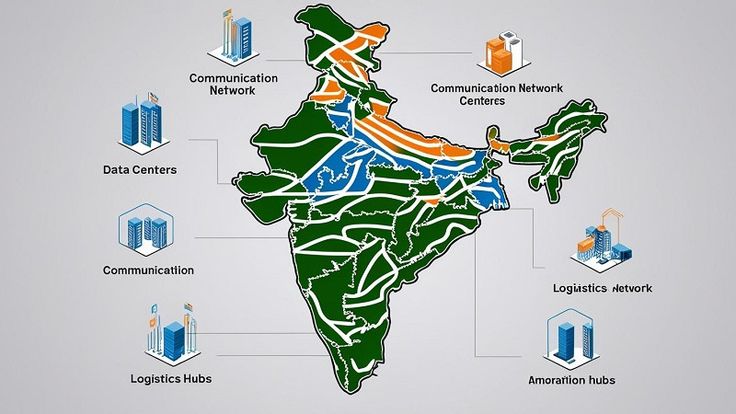
Best cities for Global Capability Centers (GCCs) in India

Global Capability Centers (GCCs) have transformed from modest back-office operations into strategic innovation hubs for multinational corporations. In India, these centers now handle everything from AI-driven product development and R&D to digital transformation and global business leadership.
As of early 2026, India hosts nearly 2,000 GCCs (with estimates ranging from 1,800–2,100 across reports from Zinnov, Nasscom, JLL, and others), employing over 1.9–2 million professionals and contributing around $64–70 billion in annual value. GCCs drove a record 31.3 million sq ft of Grade A office leasing in 2025 alone — accounting for 38% of total leasing across India’s top seven cities.
The choice of city is critical. Companies evaluate talent depth, infrastructure, operational costs, government incentives, ecosystem maturity, and quality of life. While Tier-1 cities still dominate (hosting ~92% of GCCs), the landscape is diversifying. Here are the best cities for GCCs in India in 2026, ranked by scale and momentum, with key strengths, data, and considerations.
1. Bengaluru – The Undisputed GCC Capital
Bengaluru remains India’s GCC powerhouse, commanding 34–42% of national GCC activity with 870–900+ centers (often cited as ~40% of the total base). It hosts the highest concentration of deep-tech, AI/ML, product engineering, and ER&D mandates.
Why it tops the list:
- World’s second-largest AI talent pool and ~40% of India’s ER&D talent.
- Dense startup ecosystem (3,200+ tech startups, highest number of unicorns).
- Premier institutions: IISc, IIM Bangalore, and numerous engineering colleges.
- World-class infrastructure: Whitefield, Electronic City, Manyata Tech Park, and excellent international connectivity.
Strengths: Business transformation, consulting, fintech, automotive, and semiconductors. Home to GCCs from Microsoft, Amazon, Goldman Sachs, Google, Bosch, Honeywell, and Rolls-Royce.
Challenges: Highest real estate rents (₹80–150/sq ft/month in prime areas) and salaries 10–20% above national averages; attrition ~18–24%.
Outlook: Karnataka’s GCC policy targets 500 new centers and 350,000 jobs by 2029, with a focus on “Beyond Bengaluru” innovation districts.
2. Hyderabad – The Fastest-Growing Powerhouse
Hyderabad has surged to become the clear #2 destination, with 355–550 GCCs and 20–23% market share. It led new setups in several recent periods and is now the preferred city for many mid-market and emerging-enterprise GCCs.
Key advantages:
- Specialization in pharma/biotech, life sciences, semiconductors, cloud, fintech, and platforms.
- Strong government push: Telangana AI Mission (T-AIM), AI City project, and incentives via TS-iPASS.
- Cost-effective operations (20–30% lower than Bengaluru) and improving global connectivity (new international flights).
- Talent from IIIT-H, IIT Hyderabad, and a growing digital workforce (now ~13% of India’s total tech talent).
Notable GCCs: Microsoft IDC, Amazon, Novartis, Eli Lilly, Vanguard, Wells Fargo, GE, and Carelon.
2025–2026 momentum: Record leasing growth; major expansions in healthcare-biotech and BFSI. Lower attrition and excellent quality of life make it ideal for long-term scaling.
3. Chennai – The Engineering & Manufacturing Powerhouse
With 300–312+ GCCs, Chennai has seen explosive leasing growth (one of the highest YoY increases in 2025) and is particularly attractive for industrial and engineering-focused centers.
Why companies choose Chennai:
- “Detroit of India” — highest concentration of automotive and manufacturing talent.
- Strong mid-to-senior talent pool in engineering, logistics, pharma, and SaaS.
- Competitive costs (real estate and operations significantly lower than Bengaluru).
- Proactive policies: Tamil Nadu Startup & Innovation Policy 2023 and Semiconductor & Advanced Electronics Policy 2024.
- Excellent infrastructure: Metro expansion, international airport, and port connectivity.
Key players: Ford, Renault-Nissan, Walmart, Standard Chartered, AstraZeneca, Vestas, and Societe Generale.
Edge: Stability, lower attrition than Bengaluru/Hyderabad, and growing EdTech/BFSI startup scene.
4. Pune – The Balanced Engineering & Academia Hub
Pune hosts 178–360+ GCCs (estimates vary by source; strong ~13–15% share in recent years) and is often paired with Mumbai as the western corridor.
Standout features:
- “Oxford of the East” — world-class academic institutions (IIT, College of Engineering Pune) feeding specialized engineering and automotive talent.
- Leadership in automotive, ER&D, industrial software, and SaaS GCCs.
- Lower costs than Mumbai/Bengaluru with good quality of life and green spaces.
- Maharashtra IT/ITeS Policy supporting infrastructure and exports.
Prominent GCCs: Mercedes-Benz Tech, BMW, Eaton, BNY Mellon, American Express, and Kimberly-Clark.
Growth driver: Proximity to Mumbai’s financial ecosystem while offering a calmer, talent-rich environment. Projected to cross 500 centers by 2030 in some forecasts.
5. Mumbai (MMR) – The BFSI & Corporate Capital
Mumbai and the Mumbai Metropolitan Region host 200–360+ GCCs, with a clear edge in financial services.
Why it excels:
- India’s undisputed financial capital — deep talent in banking, insurance, trading, risk management, and media.
- Proximity to regulators (RBI, SEBI), stock exchanges, and global headquarters.
- Robust infrastructure and international connectivity via airports and ports.
Notable examples: J.P. Morgan, Morgan Stanley, Citi, UBS, Goldman Sachs, Disney, and Standard Chartered.
Consideration: High real estate costs and competitive talent market, but ideal for BFSI-heavy or corporate strategy GCCs.
6. Delhi-NCR – The Strategic Northern Gateway
Delhi-NCR (Gurugram, Noida, Delhi) has 270–465+ GCCs, serving as a balanced hub for North India operations.
Strengths:
- Diverse talent pool (entry-level to senior leadership) in fintech, retail, e-commerce, consulting, travel, and SaaS.
- Proximity to government and regulators; excellent international airport connectivity.
- Mix of modern business districts (Cyber City, Noida Expressway) and multicultural lifestyle.
Key GCCs: Samsung, Pfizer, Mercer, Airbnb, Uber, Adobe, and American Express.
Advantage: Strong demand for hybrid roles combining technology with policy/regulatory expertise.
Emerging Tier-2 Cities: The Next Frontier
While Tier-1 cities still lead, Tier-2 destinations are capturing 10–14% of new setups due to 10–35% lower costs, untapped talent, and aggressive state policies:
- Coimbatore, Ahmedabad, Kochi, Chandigarh, Visakhapatnam, Jaipur, Indore: Growing in analytics, mid-size IT, design, and domain-specific GCCs.
- Gujarat’s GCC policy (CAPEX/OPEX subsidies, fast clearances) and similar initiatives in Tamil Nadu, Karnataka (“Beyond Bengaluru”), and Telangana are accelerating this shift.
- These cities offer lower attrition and faster setup times for smaller or specialized centers.
How to Choose the Right City for Your GCC
| Factor | Best for | Top Cities |
|---|---|---|
| Deep Tech / AI / Product | Innovation-heavy | Bengaluru, Hyderabad |
| Cost Efficiency | Scale & mid-market | Hyderabad, Chennai, Pune, Tier-2 |
| BFSI / Finance | Banking & risk | Mumbai, Hyderabad, Delhi-NCR |
| Automotive / Manufacturing | Engineering & R&D | Chennai, Pune |
| Pharma / Life Sciences | Biotech & healthcare | Hyderabad |
| Government / Regulatory | North India focus | Delhi-NCR |
Key decision drivers in 2026:
- Talent availability & specialization
- Total cost of operations (real estate + salaries + incentives)
- Infrastructure & connectivity
- State government support (subsidies, single-window clearances)
- Quality of life & talent retention
The Road Ahead
India’s GCC story is far from over. By 2030, the sector is projected to reach 2,400–2,500 centers, employ 2.8–2.9 million people, and generate $99–110 billion in value. The focus is shifting from pure cost arbitrage to AI-native innovation, product ownership, and strategic leadership.
South Indian cities (Bengaluru, Hyderabad, Chennai) continue to dominate leasing (~64% in early 2025 data), but the real winner will be companies that adopt a multi-city strategy — combining a flagship Tier-1 hub with cost-effective Tier-2 satellites.
For multinationals planning a GCC in India in 2026, the message is clear: Bengaluru offers unmatched ecosystem depth, Hyderabad delivers speed and specialization, while Chennai, Pune, Mumbai, and Delhi-NCR provide powerful complementary strengths. The smartest players are no longer choosing “one best city” — they’re building a networked India presence that leverages the best of each.
India isn’t just the GCC capital of the world — it’s becoming the innovation engine of global business. The cities above are where that engine runs strongest.
Leave a Comment